If you want an alone thriller movie that gets tense fast and does not bury the story under twists, Alone is a strong choice. It is a lean survival thriller about Jessica, a grieving widow whose solo road trip turns into an abduction and a fight through the Pacific Northwest wilderness. Watch it for suspense, pursuit, and a clear ending rather than mystery-box plotting or supernatural scares.
Alone movie at a glance
Alone is best approached as a stripped-down survival chase film. The appeal is not a complicated villain backstory or a huge cast; it is the pressure of watching one woman make practical, frightened decisions while a predator keeps closing in.
- Good fit: you want a tense, grounded cat-and-mouse thriller.
- Less ideal: you want supernatural horror, big plot twists, or a comforting road movie.
- Best viewing mood: a focused 98-minute watch where you are ready for sustained stress.
A 2020 survival thriller
Alone was released in 2020 and follows Jessica as she travels alone after the death of her husband. The film turns an ordinary road encounter into something far more dangerous, then shifts into survival mode once Jessica is isolated and hunted.
The movie is especially effective if you like thrillers where the danger feels physically possible: a threatening stranger, a remote road, bad timing, injury, exhaustion, and very few people nearby to help.
Directed by John Hyams
John Hyams directs with a restrained style that suits the premise. Scenes often rely on distance, silence, and small choices instead of loud explanations, which keeps the audience close to Jessica's uncertainty.
Runs for 98 minutes
At 98 minutes, the film is tight enough for a single-evening thriller watch. It does not feel padded with side plots, and once the danger becomes clear, the story keeps moving.
Set in the Pacific Northwest wilderness
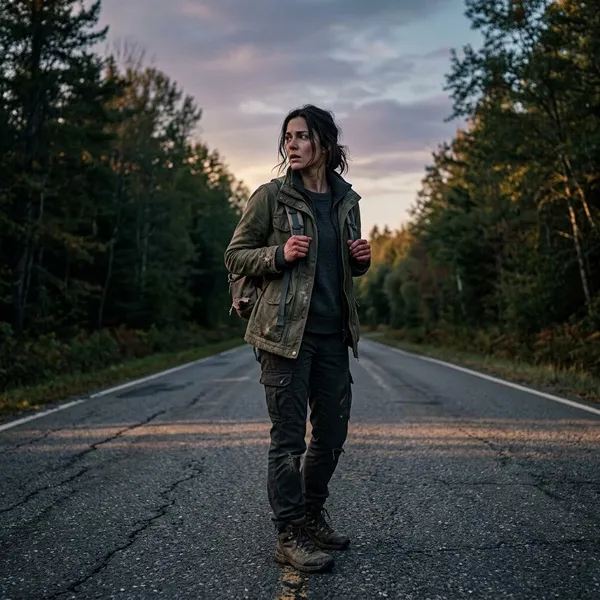
The Pacific Northwest setting is not just scenery. Empty roads, dense trees, rivers, mud, and long distances make every escape attempt harder. A city thriller would give Jessica cameras, crowds, and traffic; here, even a small mistake can leave her more exposed.
What happens in Alone
The plot is simple, but it escalates cleanly. Jessica first notices behavior that feels wrong, then realizes the threat is real, and finally has to survive without the normal safety nets of witnesses, shelter, or reliable communication.
- Road unease: Jessica repeatedly encounters the same strange man.
- Abduction: the situation turns from suspicious to openly violent.
- Escape: Jessica gets away but ends up in rough wilderness.
- Manhunt: her captor searches for her with calm persistence.
- Fight back: Jessica stops relying only on hiding and starts taking risks to survive.
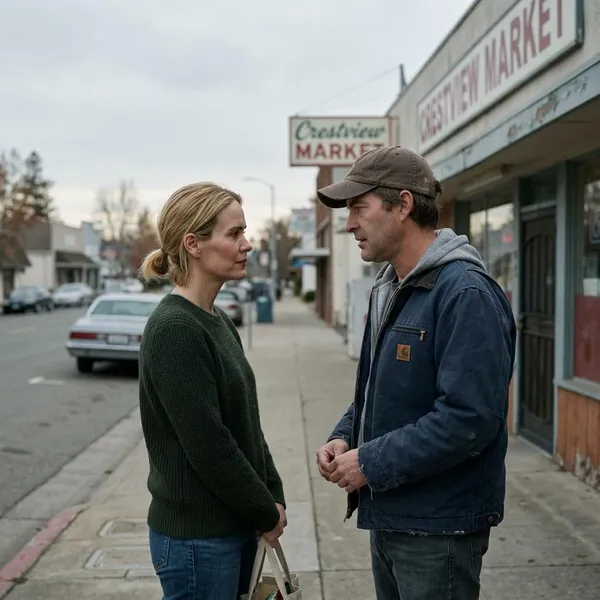
Jessica notices a stranger following her
The early tension works because the man's behavior begins in a gray area. He appears too often, drives aggressively, and seems too aware of Jessica, but the situation is not instantly obvious enough for her to feel fully safe reacting.
That is a familiar fear for anyone who has driven alone and noticed the same vehicle more than once. The film understands that danger can begin as a pattern before it becomes proof.
The stranger abducts her
Once the stranger captures Jessica, Alone becomes a direct survival thriller. The threat is no longer something she can rationalize away; she is trapped with a man who has clearly planned how to isolate and control her.
Jessica escapes into the wilderness
Jessica's escape is not a clean reset. She is no longer locked up, but she is injured, frightened, and stuck in terrain that slows her down as much as it hides her.
This is where the film becomes more than a road-stalker story. If you enjoy survival scenarios where freedom still comes with practical problems, this middle stretch is one of the strongest parts of the movie.
Her captor begins a relentless manhunt
The Man's pursuit is frightening because he does not panic. He searches with patience, and that makes the quiet moments feel unsafe rather than peaceful.
- Staying still may keep Jessica hidden, but it also gives him time to close in.
- Running creates distance, but noise and fatigue can expose her.
- Trusting someone could save her, but the film makes every encounter feel fragile.
Jessica fights back to survive
Jessica does not suddenly become an action hero. Her resistance feels earned because it comes from fear, pain, and the realization that hiding alone may not be enough.
That distinction matters. The film is satisfying because she stays believable: scared, hurt, and imperfect, but still alert enough to use the few chances she gets.
Alone cast and characters
The small cast helps the film stay tense. Because there are so few distractions, the performances have to carry long stretches of fear, suspicion, and physical strain without constant dialogue.
Jules Willcox as Jessica
Jules Willcox gives Jessica a grounded kind of resilience. She is not written as fearless, and that makes her easier to believe. Her grief, panic, and survival instinct all sit together without turning the character into a helpless victim.
For viewers who get frustrated by thriller leads making impossibly calm choices, Jessica is more convincing. She makes decisions under pressure, sometimes imperfectly, but the film lets those decisions feel human.
Marc Menchaca as the Man
Marc Menchaca plays the Man with controlled menace. He is not a shouting, theatrical villain; he is quiet enough to seem ordinary from a distance, which makes him more unsettling.
That ordinary surface is important. The character is frightening because he appears capable of moving through normal life while hiding extreme violence underneath.
Anthony Heald as Robert
Anthony Heald's Robert has limited screen time, but his role changes the emotional temperature of the film. After so much isolation, the possibility of ordinary human help suddenly feels huge.
Why Alone works as a survival thriller
Alone works because it knows what kind of movie it is. It does not chase a dozen subplots or pause to over-explain the villain. The film keeps its focus on pursuit, fear, and the practical question of how Jessica can survive the next few minutes.
A simple cat and mouse story
The central conflict is easy to understand: Jessica wants to live, and the Man wants to regain control. That clarity lets the suspense come from execution rather than confusion.
A simple setup can be a weakness when a film feels thin, but here it becomes a strength. Every scene has a clear purpose: hide, move, listen, escape, confront, or survive.
Constant danger in an isolated setting
The isolated setting keeps pressure on Jessica even when the Man is not in the frame. The wilderness gives her places to hide, but it also removes easy help.
This is why the film works better for a tense late-night watch than for casual background viewing. The stress comes from small details: sound, visibility, distance, and whether Jessica can risk moving at all.
Strong tension with little distraction
The movie avoids the common thriller mistake of adding too much. There is no bloated investigation thread, no unnecessary romance, and no long speech that drains the chase of urgency.
- The pacing stays clean because the story rarely leaves Jessica's situation.
- The danger stays personal because the villain's attention is fixed on her.
- The suspense stays readable because the goal is always survival, not puzzle-solving.
A resourceful lead worth rooting for
Jessica is compelling because her resourcefulness has limits. She observes, adapts, and takes chances, but she still suffers and makes choices under real pressure.
Alone ending explained
Jessica survives the ending of Alone, and the film gives clear closure. The final act is not about a clever twist; it is about Jessica breaking the Man's control, exposing the life he has hidden behind, and ending the immediate threat herself.
Full spoilers follow for the final sequence.
Jessica escapes from the crashed car
Near the climax, Jessica is forced into another desperate escape after a car crash. The moment fits the film's survival logic: she cannot wait for perfect conditions, because hesitation could cost her the only chance she has.
She exposes her captor to his wife
Jessica reaches the Man's home and brings his secret violence into the open. His wife's presence makes the reveal disturbing because it shows how carefully he has separated his ordinary-looking life from what he does in private.
This also changes the power dynamic. The Man's control depends on isolation and secrecy; once Jessica breaks into that hidden space, his carefully managed world starts to collapse.
The final fight shifts the balance of power
The final fight is rough rather than stylish. Jessica does not win because she is suddenly stronger than him; she wins because she keeps acting when the situation is ugly, painful, and close.
That makes the climax feel consistent with the rest of the film. Survival is not clean here. It is timing, endurance, and refusing to give the attacker back the advantage.
Jessica kills her captor
Jessica kills the Man, and the film frames it as necessary survival rather than a glamorous revenge beat. The threat has to end for the story to feel complete, and Jessica is the one who ends it.
A rescue helicopter reaches her
A rescue helicopter reaches Jessica after the confrontation, confirming that she survives. The ending does not pretend the trauma disappears, but it does give the audience the release of knowing the immediate nightmare is over.
Conclusion
Alone is worth watching if you want a focused survival thriller with a believable lead, a tense wilderness setting, and an ending that actually resolves the chase. It is not the right pick for viewers who need big twists or supernatural horror, but for a lean cat-and-mouse film built on pressure and persistence, it does its job very well.