Memento is easiest to understand once you separate the revenge story from the way the film tells it: Leonard is chasing a killer, but the movie makes you feel how unstable that chase is when memory keeps disappearing. The memento thriller movie is not confusing by accident; its structure is the point, and the ending changes how you read almost every clue that came before it.
Memento plot summary
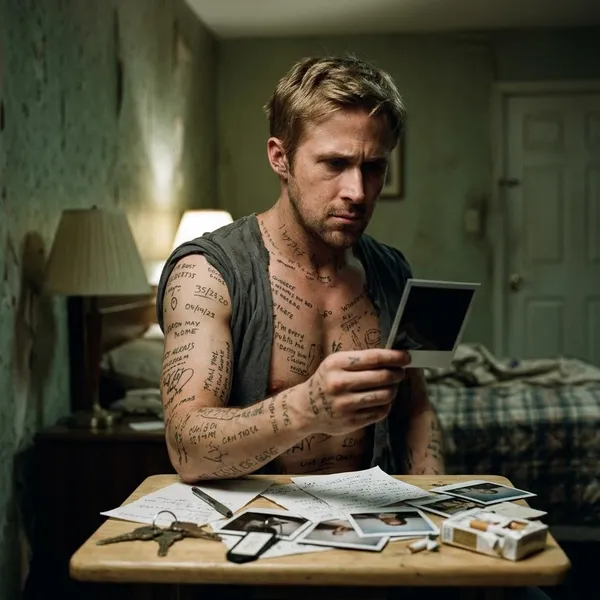
Leonard Shelby is trying to find the man he believes attacked his wife and left him with severe short-term memory loss. He can remember his life before the attack, but new experiences slip away quickly, so he builds his investigation around notes, Polaroids, and tattoos.
Leonard searches for his wife's killer
Leonard's whole life is organized around revenge. He believes a man named John G destroyed his life, and that belief gives him a reason to keep moving through days he cannot properly remember.
That mission is emotionally powerful, but it is also dangerous. If Leonard's purpose depends on always having someone to hunt, then closure becomes a threat rather than a relief.
His memory resets after several minutes
Leonard does not forget everything. He knows who he is, remembers his wife, and can function in short bursts. The problem is continuity: after a few minutes, he loses the context that most people use to judge a situation.
Notes and tattoos guide his investigation
Leonard turns his body and pockets into an external memory system. The method looks disciplined, but it has one major weakness: written evidence is only as honest as the moment when it was created.
- Tattoos feel final: they turn a clue into something Leonard treats as permanent truth.
- Polaroids feel practical: they help him identify people, but captions can be incomplete or biased.
- Handwritten notes are risky: they can be planted, misread, or written during anger and fear.
That is the first big warning in the film: Leonard's system solves one problem while creating another.
Natalie helps him follow new clues
Natalie gives Leonard information he needs, but she is not a clean helper figure. She has her own grief, pressure, and reasons to push him toward certain actions.
Her scenes matter because they show the everyday danger of Leonard's condition. Someone does not need a grand conspiracy to manipulate him; they only need to understand what he will forget.
Teddy challenges everything he believes
Teddy is the character who makes Leonard's mission unstable. He acts like a guide, talks like someone who knows the truth, and still behaves in ways that make him hard to trust.
The key is not deciding that Teddy is purely honest or purely false. The more useful reading is that Teddy may tell Leonard truths for selfish reasons, while Leonard may reject those truths because they would leave him with nothing to live for.
Memento cast
The cast keeps Memento from becoming only a clever puzzle. Each performance gives the story a different kind of pressure: Leonard's desperation, Natalie's guarded anger, Teddy's slippery familiarity, and the smaller characters' willingness to take advantage of weakness.
Guy Pearce as Leonard Shelby
Guy Pearce makes Leonard sharp and vulnerable at the same time. He is not played as helpless; he is controlled, observant, and often intense. That makes his mistakes more unsettling, because they come from a man who is trying very hard to be logical.
On a rewatch, Pearce's performance becomes even more interesting. Small pauses and bursts of certainty start to look less like detective confidence and more like a man protecting the version of reality he needs.
Carrie Anne Moss as Natalie
Carrie-Anne Moss gives Natalie a cold, wounded edge. She can be sympathetic in one scene and cruel in another, which fits a film where help and exploitation often look almost the same.
Joe Pantoliano as Teddy
Joe Pantoliano plays Teddy with the right amount of charm and threat. He seems too casual to be safe, but too familiar with Leonard to dismiss completely.
That balance is why Teddy works so well. If he were obviously lying, the ending would be simple. If he were obviously trustworthy, Leonard's choice would be simple. Pantoliano keeps both options alive.
Stephen Tobolowsky as Sammy Jankis
Stephen Tobolowsky's Sammy Jankis scenes look separate at first, but they are central to the film's deeper mystery. Sammy is the story Leonard uses to explain memory, habit, and failure.
The practical thing to watch is how often Leonard uses Sammy as proof. Once that proof becomes questionable, Leonard's entire self-understanding starts to crack.
Mark Boone Junior as Burt
Mark Boone Junior's Burt, the motel clerk, shows a quieter kind of exploitation. Renting Leonard multiple rooms is not a huge plot twist, but it tells you a lot about the world Leonard is moving through.
Not every danger in Memento is dramatic. Some people simply notice that Leonard can be fooled and decide to benefit from it.
Callum Keith Rennie as Dodd
Callum Keith Rennie makes Dodd feel volatile and physical, which gives the film a more immediate kind of danger. Dodd is not the central mystery, but his presence shows how easily Leonard can be pulled into conflicts he barely understands.
How the Memento timeline works
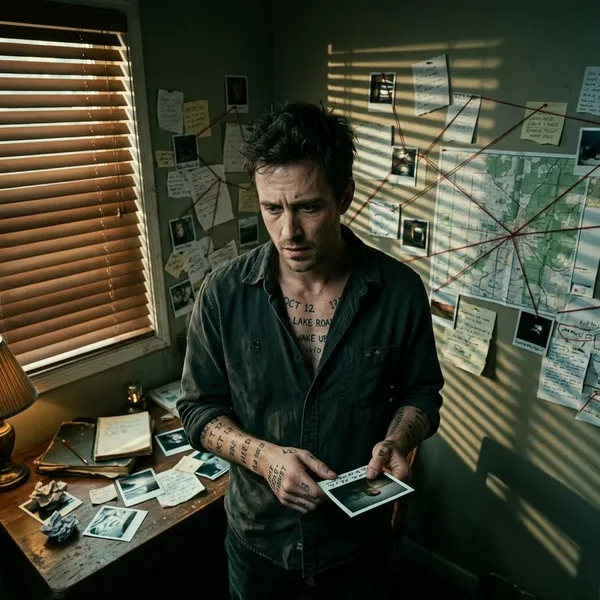
The timeline is easier to follow if you split it into two tracks. The color scenes move backward, while the black-and-white scenes move forward. Those tracks meet after Jimmy's death, and that meeting point explains why the opening scene is actually the end of the story's chronology.
If you are watching for the first time, do not try to solve everything immediately. Track scene direction first, character trust second, and the ending interpretation last.
Color scenes move backward
The color scenes show the story in reverse order. Each color scene explains what led to the color scene you just watched, so the film repeatedly gives you the effect before the cause.
That is why normal thriller instincts can mislead you. Instead of asking "What happens next?", the better question is "What happened just before this?"
Black and white scenes move forward
The black-and-white scenes move in normal chronological order. They show Leonard in a motel room, talking on the phone and explaining Sammy Jankis, his condition, and the rules he claims to live by.
They feel calmer than the color scenes, but that does not mean they are fully safe. Leonard is still the filter, and his explanations may contain gaps he cannot or will not see.
The two timelines meet after Jimmy's death
The meeting point comes after Leonard kills Jimmy Grants. The black-and-white footage shifts into color, joining the two tracks and revealing that the "separate" storylines were moving toward the same moment.
- Before the meeting point: Leonard is being guided toward Jimmy while explaining his condition.
- At the meeting point: Jimmy's death exposes how fragile Leonard's certainty is.
- After the meeting point: Leonard chooses evidence that will eventually point him toward Teddy.
The opening murder happens last
The opening scene, where Leonard kills Teddy, happens last in the true chronology. Nolan shows the endpoint first, then spends the film revealing how Leonard arrived there.
That choice makes the ending more tragic. Leonard is not simply solving a case; he is creating the conditions that allow the case to keep going.
The structure mirrors Leonard's confusion
The structure works because it puts the viewer in Leonard's position. You enter scenes without enough context, judge people too quickly, and then have to revise your opinion when the missing piece appears.
For someone watching casually, that can feel frustrating. For someone willing to meet the film halfway, it becomes the main emotional experience: the editing is not a trick pasted onto the story, but the way the story lets you feel Leonard's damaged reality.
Memento themes and meaning
Memento is remembered for its structure, but the film lasts because its ideas are uncomfortable. It asks whether truth is still valuable when a person cannot live with it, and whether identity can survive when memory no longer gives life a continuous shape.
Memory shapes personal identity
Leonard still has intelligence, habits, and old memories, but he cannot build a stable present. That makes his identity dependent on objects: tattoos, notes, photos, routines, and repeated stories.
The film's bleak suggestion is that identity is not just something inside you. It is also built from remembered choices. Without that thread, Leonard becomes easier to rewrite.
Facts can be manipulated
Memento does not say facts are useless. It says facts become dangerous when they are selected dishonestly or interpreted by someone who needs a certain answer.
Leonard's tattoos look objective, but they are not neutral. A false conclusion can become permanent if he chooses to preserve it, and a true fact can be ignored if it threatens his purpose.
Grief gives Leonard a purpose
Leonard's grief is the engine of the story. Revenge gives his broken days a direction, which is why the possibility of closure is so frightening.
One way to read the film is as a warning about purpose built entirely on pain. If the hunt ends, Leonard loses the role that tells him who he is.
Self-deception protects him from the truth
The ending strongly suggests that Leonard is not only being deceived by others. He also chooses a lie that will keep him moving.
That is what makes the final twist harsher than a simple reveal. Leonard's condition makes him vulnerable, but his final decision makes him responsible in a more disturbing way: he plants the next story for his future self to believe.
Conclusion
Memento works best when you stop treating it as a puzzle with one neat trick and start seeing it as a tragedy about a man who needs the chase more than the truth. The timeline explains the mechanics, but the lasting punch comes from Leonard's choice to protect his purpose, even if that means building his life around another lie.