If you want a recent spy thriller movie to watch tonight, pick by mood first: smart suspicion, revenge, surveillance paranoia, or full-scale action. Black Bag is the strongest starting point for a controlled, dialogue-driven spy drama, while Mission: Impossible The Final Reckoning is the safest choice when you want spectacle. If you would rather watch something personal, tech-heavy, or more paranoid, the better pick changes quickly.
Which recent spy thriller should you watch first?
The quickest way to choose is not to rank every title as "best." Spy thrillers work better when the tone matches the night. A quiet solo watch can handle slow suspicion and moral ambiguity; a weekend group movie usually needs clearer stakes, faster pacing, and less patience.
| If you want... | Start with | Why it fits |
|---|---|---|
| Smart suspicion | Black Bag | A mole-list premise with intimate trust issues |
| Personal revenge | The Amateur | Espionage driven by grief and retaliation |
| Big action | Mission: Impossible The Final Reckoning | Large missions, stunts, and franchise-scale danger |
| Paranoia and surveillance | Relay | Protection, exposure, whistleblowers, and systems |
| Easy streaming-style espionage | Heart of Stone | Modern tech threat with accessible pacing |
Recent spy thrillers by style
Recent spy thriller movies split into several very different lanes. The mistake is choosing only by cast, poster, or release date. A mole hunt, a CIA revenge story, and a high-tech action film may all count as espionage, but they create completely different evenings.
If you are choosing for yourself, start with the kind of tension you actually enjoy. If you are choosing for a group, favor clearer stakes and faster movement unless everyone already likes slow-burn spy stories.
Mole hunts and double agents
Mole hunts work best when you want suspicion instead of spectacle. Black Bag and Scare Out fit this lane because the main question is not simply "Can the hero survive?" but "Who is lying, and how long have they been lying?"
This style rewards attention. A small contradiction, a private meeting, or a change in tone can matter more than a fight scene. It is a strong choice for viewers who like Tinker Tailor Soldier Spy-style patience, but it can feel too restrained if you want constant action.
CIA revenge stories
CIA revenge stories are easier to enter because the motive is personal before it is political. The Amateur works in this category because the mission grows out of loss, not just agency orders or abstract national security language.
The risk with this style is predictability: revenge can become a straight line if the film does not complicate the lead's choices. Look for stories where the character's skills, limits, and moral decisions matter, not just the body count.
Global action missions
This is the right lane when the night calls for speed. Mission: Impossible The Final Reckoning, Heart of Stone, and Agent Zeta all use international movement, visible danger, and bigger operational stakes.
- Pick this for a group: the goals are usually easy to understand.
- Pick this for energy: pacing matters more than realism.
- Be cautious if you dislike excess: the plots can get loud or oversized.
Surveillance and whistleblowers
Surveillance thrillers make information feel unsafe. Relay is the cleanest match here because the suspense comes from systems, communication, protection, and the fear of being exposed.
This style is especially effective if you already find digital tracking, leaks, and institutional pressure unsettling. It is less about who wins a fistfight and more about whether anyone can stay hidden long enough to make the truth matter.
State security investigations
State security investigation stories are slower and more procedural. They focus on inquiries, classified evidence, political pressure, internal failures, and the uneasy overlap between intelligence work and law enforcement.
Choose this style when you want realism and institutional tension. It is not always the most entertaining branch for a casual movie night, but it can be the most satisfying if you like serious thrillers where paperwork, interviews, and official denials carry real weight.
High-tech espionage
High-tech espionage is built around systems: predictive tools, digital surveillance, cyber access, biometric tracking, and intelligence platforms that can shift power quickly. Heart of Stone is the most direct pick from this group, while big franchise spy films often borrow the same anxiety.
How to choose a recent spy thriller
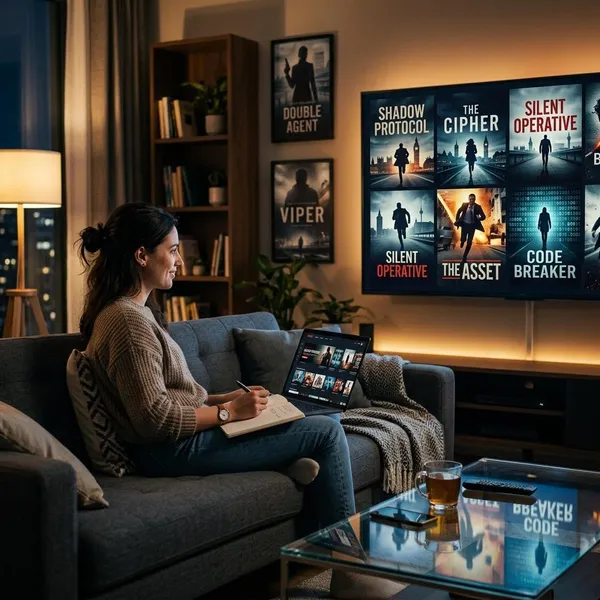
Before you search every platform, decide three things: how much realism you want, how fast you want the story to move, and whether you care more about personal emotion or global stakes. That order saves time because availability should be the final filter, not the first one.
Choose realistic or action-heavy
If you want realism, start with films where secrecy, communication, mistrust, and institutional pressure create the danger. Black Bag and Relay are better fits for that mood than a stunt-driven franchise entry.
If you want action-heavy entertainment, go straight to Mission: Impossible The Final Reckoning, Heart of Stone, or Agent Zeta. A common mistake is choosing a "realistic" spy film for a high-energy group night, then wondering why everyone gets restless halfway through.
Pick slow tension or fast pacing
Slow tension is best when you can actually pay attention. Choose it for a quiet night, headphones on, phone away, and a willingness to track small details. Fast pacing is better when you want the movie to carry the room without everyone studying every line.
- Slow and tense: Black Bag, Relay, Scare Out.
- Fast and broad: Mission: Impossible, Heart of Stone, Agent Zeta.
- Middle ground: The Amateur, because the emotional drive keeps it moving.
Choose political or personal stakes
Political stakes work when you want governments, agencies, alliances, and wider consequences. Personal stakes work when you want grief, marriage, betrayal, or revenge to make the danger feel closer.
For a more intimate watch, choose Black Bag or The Amateur. For a bigger, world-risk feeling, choose Mission: Impossible The Final Reckoning or Heart of Stone. Neither approach is better; the wrong one just feels unsatisfying on the wrong night.
Pick a standalone film or franchise
Choose a standalone film if you do not want homework. Black Bag, Relay, The Amateur, and Scare Out are easier to approach when you want one complete story.
A franchise entry makes more sense if you already like the characters, the tone, and the established style. With Mission: Impossible, prior familiarity can add emotional payoff, but the main attraction is still the action design and mission momentum.
Check current streaming availability
Availability changes by region, platform, and release window, so check it last. First decide the style you want, then search your main subscriptions, then rental options. If a title is not available at a reasonable price, switch to the closest style match instead of restarting the whole search.
- Pick the mood: smart, personal, paranoid, or action-heavy.
- Match the room: solo viewers can go slower; groups usually need pace.
- Check platforms: subscription first, rental second.
- Watch a current trailer: tone is easier to judge than from a poster.
- Stop scrolling: once it fits the mood and is available, press play.
Conclusion
The best choice is the one that matches the kind of pressure you want to feel. Go with Black Bag for controlled mistrust, The Amateur for a personal revenge angle, Relay for surveillance paranoia, and Mission: Impossible The Final Reckoning when only large-scale action will do. Treat availability as the last check, not the main decision, and recent spy thriller movies become much easier to choose without wasting half the night scrolling.