If you are deciding whether the seven thriller movie Se7en is still worth your time, the answer is yes—but only if you want a bleak, patient crime story rather than a fun mystery night. It is gripping, beautifully controlled, and still disturbing, but it is also the kind of film you should avoid if you want comfort, closure, or light suspense.
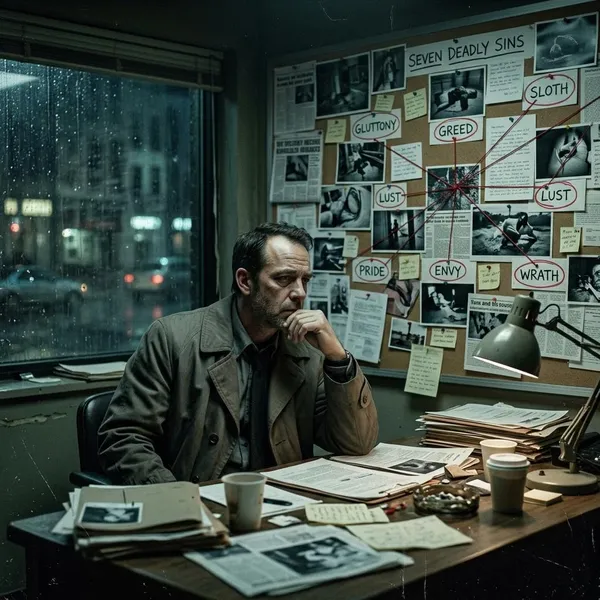
Is Se7en worth watching?
Se7en is worth watching for viewers who like serious crime thrillers with atmosphere, character pressure, and a final act that changes how the whole story feels. It is not a fast, twist-every-five-minutes mystery. The movie works because it slowly tightens around two detectives until the case becomes personal and almost impossible to escape.
Best for dark crime thriller fans
Fans of grim detective stories will probably get the most from Se7en. The murders are staged around the seven deadly sins, but the appeal is not just the killer's pattern. The city feels rotten, the detectives are worn down in different ways, and the case has a moral weight that makes it feel heavier than a standard serial-killer puzzle.
Best for slow-building suspense
The film is strongest when you let it move at its own pace. It spends time on crime scenes, conversations, and the clash between Somerset's caution and Mills's impatience, so the suspense builds through mood rather than constant shocks.
- Good fit: you enjoy slow investigations, bleak atmosphere, and careful character tension.
- Bad fit: you want quick answers, frequent action, or a clean detective victory.
- Best viewing situation: watch without distractions, because small reactions and conversations matter later.
Best for viewers who enjoy bleak endings
Se7en is famous because it commits fully to its bleak ending. The finale is not a last-minute shock added for effect; it is the point the whole movie has been moving toward.
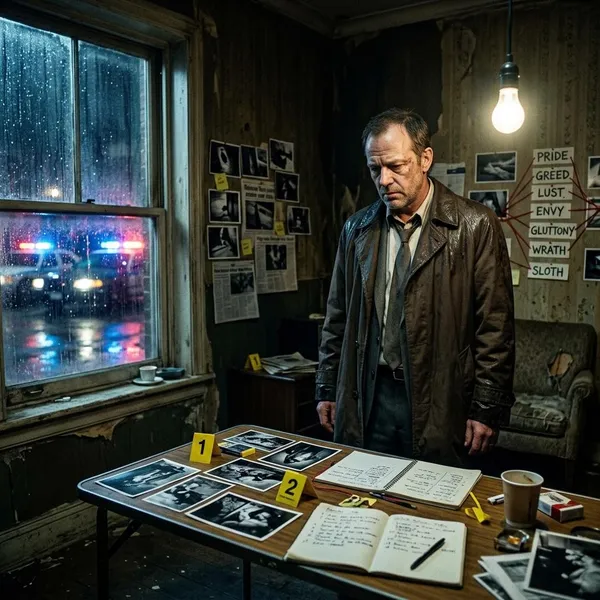
Se7en plot summary
Se7en follows Detective William Somerset, a thoughtful veteran close to retirement, and Detective David Mills, a younger detective who has just transferred into the city. They are pulled into a serial murder case where each killing is designed around one of the seven deadly sins.
Somerset and Mills take the case
Somerset and Mills are not simply "old cop and young cop" opposites. Somerset is careful because he has seen too much; Mills is forceful because he still believes action can cut through corruption. Their first cases together show how badly they need each other and how easily their styles can clash.
The deadly sin pattern emerges
The murders connect to gluttony, greed, sloth, lust, and pride before the final two sins come into focus. Each crime is arranged as a grotesque judgment, with John Doe presenting himself as someone exposing moral decay rather than committing ordinary murder.
The pattern matters because it changes the case from "find the killer" to "understand the sermon." Doe wants the detectives, the press, and the public to look at his victims as symbols. The film does not endorse that view, but it makes his fanatic certainty unsettlingly clear.
John Doe turns himself in
John Doe's surrender is the twist that changes the movie's direction. He walks into the police station covered in blood, not as someone defeated, but as someone who believes the most important part of his plan is still ahead.
From that moment, the detectives have technically caught the killer, yet the danger feels worse. Somerset senses that Doe is still controlling the shape of the case. Mills sees the possibility of closure and becomes more vulnerable to the emotional trap being prepared for him.
The detectives follow his final plan
Doe offers to lead Somerset and Mills to the last two victims. The choice is risky, but refusing him may mean losing the only chance to understand what remains. The move also pulls the story out of the rain-soaked city and into an exposed desert landscape, where there is nowhere for the characters' emotions to hide.
- Doe controls the setting: the detectives are isolated from normal police routines.
- A package arrives: Somerset checks it first and understands the horror before Mills does.
- Doe names his sin: he admits to envy and uses Mills's private life as the final weapon.
- Mills faces the trap: if he kills Doe, he becomes wrath and completes the pattern.
Se7en ending explained
The ending works because the detectives solve the case and still lose. John Doe does not need to escape to win. His goal is to force Mills into an act of wrath, turning the detective into the final piece of the seven-sin design.
Somerset understands the trap before Mills fully does, which makes the scene even more painful. Knowledge is not enough. Procedure is not enough. The last decision happens inside Mills's grief, and Doe has built the moment so that rage feels almost impossible to resist.
What is inside the box
The box contains Tracy Mills's severed head. The film never shows it directly, and that restraint makes the reveal more disturbing. Somerset's reaction, Doe's words, and Mills's collapse give the audience everything needed without turning the moment into a graphic display.
Why John Doe targets Mills
Doe targets Mills for two reasons: envy and strategy. He envies Mills's marriage and the normal life it suggests, but he also sees Mills's temper as the weakness that can finish the design.
Somerset would be harder to push into blind violence because his despair has made him controlled. Mills is different. He cares deeply, reacts quickly, and struggles to keep emotion separate from duty. Doe chooses him because grief can be turned into wrath.
Why Mills completes the final sin
Mills kills Doe because the truth about Tracy breaks him. He is still responsible for pulling the trigger, but the film makes clear that Doe has engineered the cruelest possible moment for that choice.
- His flaw was already visible: Mills has been impulsive throughout the story.
- The attack is personal: Doe destroys the part of Mills's life that was separate from the case.
- Somerset cannot reach him: reason arrives too late against shock, grief, and rage.
What Somerset's final words mean
Somerset quotes the idea that "the world is a fine place and worth fighting for," then says he agrees with the second part. That line is not a sudden happy note. He is not pretending the world is fine after everything he has seen.
His point is more modest and more convincing: the world can be ugly and still be worth resisting. Somerset begins the film ready to step away from the damage around him. He ends it still wounded, but not completely surrendered to despair.
What Se7en is really about
Se7en is about more than a killer using the seven deadly sins. It is about what people do when the world feels corrupt, exhausting, and morally broken. John Doe responds with fanatic punishment. Somerset responds with tired distance. Mills responds with anger and belief in action.
Sin and punishment
John Doe treats sin as permission to punish. In his mind, the victims are examples, and his murders are messages meant to wake up a numb society.
The film shows how dangerous that kind of certainty becomes. Once Doe decides he alone can measure guilt, cruelty starts to look righteous to him. That is the horror behind his philosophy: moral language becomes a mask for sadism and control.
Rage and despair
Mills and Somerset carry different kinds of damage. Mills's rage comes from caring and wanting the world to make sense. Somerset's despair comes from understanding how often it does not.
Neither response is safe on its own. Mills's anger gives him energy, but it also makes him easy to provoke. Somerset's restraint protects him from reckless choices, but it can become withdrawal. Doe's final plan works because it presses on both wounds at once.
Justice and moral failure
The detectives do catch John Doe, but the ending still feels like failure because legal success does not prevent emotional ruin. That is one of the film's sharpest ideas: solving the case is not the same as defeating what the killer set in motion.
This is also why Se7en feels different from a cleaner police thriller. The system can process evidence, identify a suspect, and surround a crime scene, yet it cannot fully protect Mills from the choice Doe wants him to make.
Hope in a corrupt world
The hope in Se7en is small, not comforting. Tracy's warmth, Somerset's concern for Mills, and his final refusal to give up completely are the few signs that decency still matters.
For a viewer who dislikes bleak films, that may not be enough. For someone drawn to darker stories, it is exactly what keeps the movie from becoming empty nihilism. The film does not say goodness wins easily; it says giving up is also a choice.
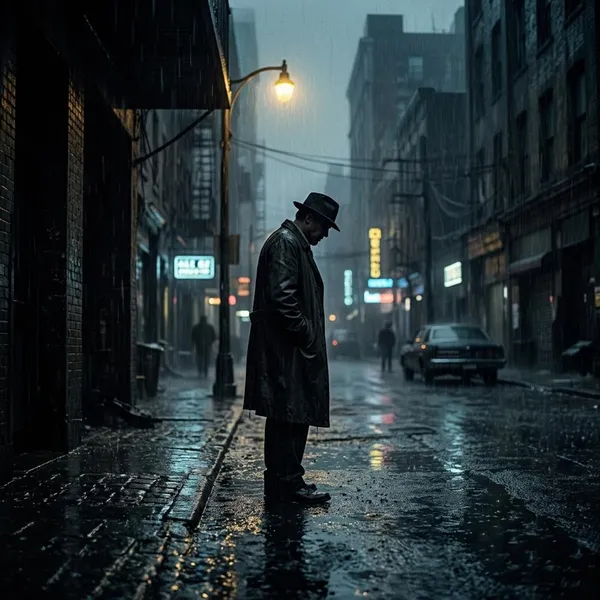
Why Se7en still feels so powerful
Se7en still works because it is controlled rather than loud. David Fincher's direction, the performances, the production design, and the pacing all serve the same feeling: a world closing in on people who are trying to stay morally awake.
The movie also avoids many things that date thrillers quickly. It does not rely on fashionable references, excessive explanations, or technology-heavy plotting. Its fears are basic and durable: cruelty, numbness, anger, pride, and the possibility that a person can be pushed past their limit.
A grim and timeless setting
The unnamed city is one of the film's smartest choices. It is rainy, crowded, dirty, and oppressive, but never tied too neatly to one real location. That makes it feel less like a place on a map and more like a moral atmosphere.
Strong detective chemistry
Brad Pitt and Morgan Freeman give the film its human balance. Freeman's Somerset is calm, observant, and quietly sad; Pitt's Mills is proud, impatient, and more vulnerable than he wants to admit.
Their partnership matters because they are not just trading case details. They are arguing, sometimes indirectly, about how to live in a world that keeps showing its worst side. That emotional contrast gives the investigation a pulse even during slower scenes.
Carefully controlled tension
The tension comes from patience. Crime scenes are not rushed. Reactions linger. Quiet conversations are allowed to feel uneasy. The movie understands that dread often grows stronger when the audience has time to sit with what has happened.
- Rain and darkness: the city scenes feel trapped and suffocating.
- Silence and routine: ordinary police work becomes heavy instead of reassuring.
- Daylight in the finale: the desert proves the ending does not need darkness to feel horrifying.
An unforgettable final act
The final act is unforgettable because it strips the thriller down to a terrible choice. There is no elaborate chase, no clever rescue, and no last-second reversal. The scene depends on performance, timing, and the unbearable gap between what Somerset understands and what Mills can emotionally survive.
It also changes the movie in retrospect. Mills's temper, Tracy's vulnerability, Somerset's fatigue, and Doe's patience all become more important once the final design is clear. That is why the ending remains talked about: it does not just shock the audience, it completes the film.
Conclusion
Se7en is still worth watching if you want a dark crime thriller that trusts atmosphere, character, and moral pressure more than easy thrills. It is not the right pick for a comforting movie night, but for viewers ready for a bleak detective story with a devastating payoff, it remains one of the rare thrillers whose ending feels earned rather than simply shocking.