If you want war thriller movies that feel tense rather than just loud, start with films where the mission is clear, the danger keeps shifting, and the characters have very little room to recover. 1917, Das Boot, The Hurt Locker, Zero Dark Thirty, and Eye in the Sky are the easiest entry points because each one creates suspense in a different way: combat, confinement, psychology, intelligence, or moral pressure.
Best war thriller movies to watch
The best place to start depends on what kind of tension you enjoy. If you want immediate battlefield pressure, choose 1917 or Black Hawk Down. If you prefer suspense that builds through waiting, uncertainty, and difficult decisions, Das Boot, Zero Dark Thirty, and Eye in the Sky are stronger picks.
1917
1917 is the most direct choice if you want a war thriller that almost never lets you breathe. Two British soldiers must cross enemy territory to deliver a message that could prevent a disastrous attack, and the film turns that single objective into constant forward pressure.
The near-continuous-shot style is not just a visual trick. It keeps you trapped beside the soldiers as they move through trenches, ruins, open ground, and sudden danger. For viewers who want suspense without needing a complicated plot, this is one of the clearest modern recommendations.
Das Boot
For claustrophobic survival, Das Boot is hard to beat. Set inside a German U-boat during World War II, it makes the submarine feel cramped, fragile, and increasingly unsafe. The tension comes from depth charges, mechanical strain, exhaustion, and the terrible fact that there is nowhere normal to run.
The Hurt Locker
The Hurt Locker is ideal if you want a modern war thriller where danger hides in ordinary places. A roadside object, a parked car, a rooftop, or a watching crowd can all become part of the threat because the film follows a bomb disposal unit in Iraq.
- Watch it for: psychological pressure and hidden danger.
- Skip it if: you only want large battle scenes.
- Best moment-to-moment tension: scenes where nobody can tell whether the area is safe.
Zero Dark Thirty
Zero Dark Thirty turns the search for Osama bin Laden into a slow, tense intelligence thriller. The suspense comes from leads that may be wrong, information that arrives too late, and the pressure of acting on incomplete certainty.
It is especially strong for viewers who like procedural tension. The final raid works because the film has already spent so much time showing how fragile the trail was.
Eye in the Sky
Eye in the Sky is the best choice here if you want moral suspense more than combat. Much of the film happens in control rooms, but the stakes feel immediate because a drone strike decision involves military urgency, civilian risk, legal pressure, and political hesitation.
'71
'71 follows a young British soldier separated from his unit during the Troubles in Northern Ireland. It works because he does not fully understand the streets, the factions, or who might help him.
The film is lean, urban, and anxious. If you want something outside the usual World War or Middle East settings, this is one of the sharper choices because the suspense comes from confusion rather than spectacle.
Anthropoid
Anthropoid focuses on the mission to assassinate Reinhard Heydrich during World War II. The strongest parts are built around secrecy, timing, resistance networks, and the knowledge that failure would bring brutal consequences.
It suits viewers who want a war thriller with historical weight. The film is suspenseful, but it never treats the mission like a clean adventure; the cost is always close.
Black Hawk Down
Black Hawk Down is the pick for intense combat escalation. Based on the 1993 Battle of Mogadishu, it follows a mission that collapses into a dangerous urban fight after helicopters are shot down.
Choose this when you want scale, noise, tactical danger, and a strong sense of plans falling apart. It is less of a mystery thriller and more of a survival-under-fire experience.
War thriller movies by type
War thrillers do not all create suspense the same way. Some make you worry about the next street corner; others make you wait for a command decision, a hidden bomb, or a betrayal. Thinking by type is often more useful than sorting by decade.
For a first-time viewer, combat and survival thrillers are the easiest to enter. If you already like slower suspense, espionage and psychological war thrillers may be more rewarding.
Combat thrillers
Combat thrillers are built around missions, movement, and immediate physical danger. The best ones keep the objective simple, then make every step harder. 1917 needs a message delivered; Black Hawk Down needs soldiers to survive a collapsing operation.
This type is best if you want urgency from the start. The common mistake is choosing a combat thriller when you actually want strategy or moral suspense; in that case, Eye in the Sky or Zero Dark Thirty will probably fit better.
Psychological war thrillers
Psychological war thrillers care less about who wins a battle and more about what pressure does to a person. The Hurt Locker is the obvious example because the danger is both external and internal: bombs may kill the soldiers, but adrenaline and obsession also change how they behave.
Espionage thrillers
Espionage war thrillers use information as the battlefield. A delayed order, a bad assumption, a false lead, or a surveillance image can matter as much as a firefight.
- Best for patient viewers: Zero Dark Thirty.
- Best for ethical pressure: Eye in the Sky.
- Best viewing mood: when you want suspense built from details rather than constant combat.
Resistance thrillers
Resistance thrillers usually feel more personal because the characters are exposed. They may have safe houses, secret contacts, and a plan, but they rarely have the protection of a regular army. Anthropoid works because trust is fragile and every movement can draw attention.
Survival thrillers
Survival thrillers reduce the question to one thing: can the character or group last long enough to escape? Das Boot traps a crew underwater; '71 traps a soldier in a hostile city. The settings are completely different, but the pressure is similar.
Choose this type for a late-night, edge-of-the-seat watch. It is usually less about military history and more about making one correct decision after another.
Best war thrillers for different conflicts
Different conflicts create different kinds of fear. Trench warfare makes distance and exposure terrifying. Submarine warfare turns machinery and oxygen into suspense. Modern conflicts often rely on hidden threats, intelligence work, drones, and urban confusion.
If you are choosing with someone else, this is the easiest way to avoid a mismatch: pick the conflict first, then the tension style. A viewer who wants World War II atmosphere may not want the same film as someone looking for modern counterterrorism suspense.
1917 for World War I
1917 is the cleanest World War I recommendation because it turns trench warfare into a survival mission with a ticking clock. You do not need deep background knowledge to feel the danger: the open ground, ruined terrain, broken communication, and sudden violence do the work.
Das Boot for World War II
Das Boot is a strong World War II pick for viewers who want atmosphere rather than a broad campaign story. It shows the war from inside a sealed, vulnerable space where pressure, sound, depth, and mechanical failure become part of the enemy.
If you usually find older war films slow, give this one time. Its suspense builds through confinement, not speed.
'71 for the Troubles
'71 is the best fit for the Troubles because it keeps the conflict immediate and disorienting. The main character is not solving the politics of Northern Ireland; he is trying to survive one night in a place where every street can change the risk.
The Hurt Locker for the Iraq War
The Hurt Locker captures the Iraq War through hidden danger and routine missions that never feel routine. Its strongest suspense comes from uncertainty: nobody can safely assume which object, building, or bystander is harmless.
Eye in the Sky for modern drone warfare
Eye in the Sky fits modern drone warfare because it shows how distance does not remove responsibility. The people making decisions are far from the target, yet the pressure is immediate because the consequences may be irreversible.
What makes war thrillers so tense
War thrillers work best when the viewer understands the goal but not the cost. A mission may sound simple, yet the characters have incomplete information, limited time, and no safe way to pause. That combination makes even quiet scenes feel unstable.
Before choosing one, check what kind of pressure the film uses. If you want movement, pick a mission film. If you want dread, pick survival or psychological suspense. If you want arguments after the credits, pick a moral or intelligence-driven thriller.
Missions create constant pressure
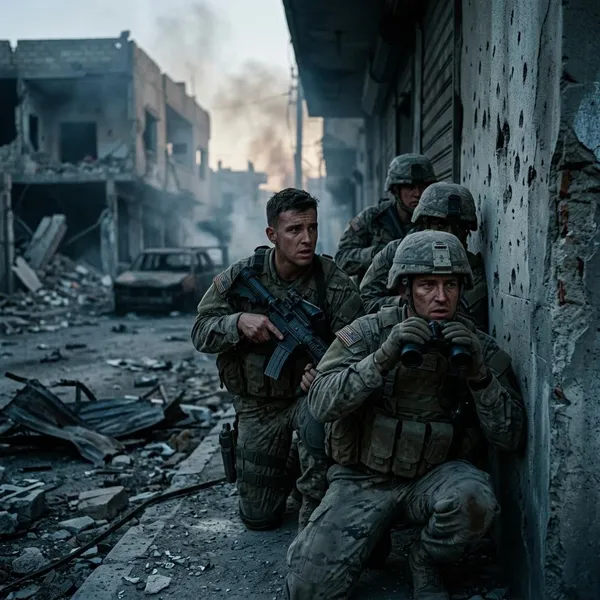
A clear mission gives a war thriller its spine. Deliver the message, defuse the bomb, identify the target, reach extraction, survive the night. When the goal is easy to understand, every delay or mistake becomes more stressful.
Enemy threats stay unpredictable
Unpredictable threats keep the audience alert because danger does not always arrive as a visible enemy. It might be a sniper, an IED, a failed radio, a false lead, a civilian casualty risk, or a person who cannot be trusted.
Survival raises every decision
Survival pressure makes small choices feel huge. Crossing a street, opening a hatch, trusting a stranger, or waiting one more minute can change everything. That is why Das Boot and '71 can feel as tense as larger combat films despite their narrower focus.
This is also where war thrillers differ from ordinary action movies. The best ones make you feel the cost of a wrong decision before anything happens.
Isolation limits escape
Isolation is one of the genre's most reliable tension tools. A trapped submarine crew, a separated soldier, or a command team cut off from events on the ground all face the same problem: help is limited, late, or morally complicated.
- Physical isolation: no easy route out, as in Das Boot.
- Urban isolation: no clear safe person or street, as in '71.
- Command isolation: decisions made from a distance, as in Eye in the Sky.
Moral choices add uncertainty
Moral choices give war thrillers their aftertaste. A mission can succeed and still feel troubling if civilians were endangered, intelligence was uncertain, or the people making the call had no clean option.
For viewers who do not enjoy heavy combat, this is often the best route into the genre. Films like Eye in the Sky prove that a room full of people arguing over one decision can be as tense as a battlefield.
Conclusion
The strongest choice is not always the biggest or most famous war film; it is the one that matches the kind of pressure you want to feel. Start with 1917 for momentum, Das Boot for confinement, The Hurt Locker for psychological danger, Zero Dark Thirty for intelligence-driven suspense, or Eye in the Sky for moral tension. Once you know which type grips you most, the rest of the genre becomes much easier to explore.